
A significant and long-fought victory for Eel River salmon and steelhead was won in 2004 when FERC issued an order amending PG&E’s 1983 operating license for the Potter Valley Project. These amendments included improved in-stream flows plus water quality and flow verification in the upper mainstem of the Eel. CalTrout’s involvement in the contentious issue of in-stream flows on the upper Eel dates back to the early ‘70s, when the organization filed formal intervention papers with FERC and was granted formal intervener status in the relicensing proceeding, a first for any non-profit nationwide.
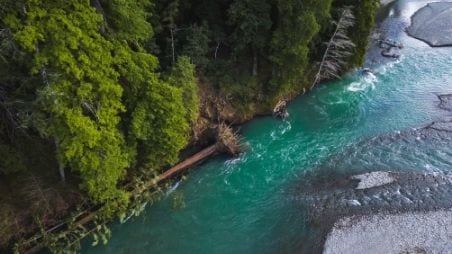
CalTrout remains deeply involved in the Eel River, from headwaters to the sea. Key projects implemented include estuary restoration, fish barrier removal on tributaries such as Bridge and Woodman Creeks, innovative streamflow work on the South Fork Eel, and dam relicensing of the Potter Valley Project.
CalTrout also conceived and formed the Eel River Forum, which coordinates conservation and recovery efforts on the Eel River. The Forum is a collection of diverse interests working together to help realize the Eel River’s tremendous potential to be the most important producer of wild fish along the entire western United States. The Eel is a key stronghold for California’s native wild fish. However, Eel River flows are threatened by a fast expanding marijuana industry and both legal and illegal diversions. To protect these flows, CalTrout is implementing cutting-edge streamflow work on Sproul Creek in the South Fork Eel River basin, demonstrating that integrated science and policy can balance the needs of wild fish and people, and that this key wild fish stronghold can be protected.
Sign up to hear from California Trout! CalTrout’s mission is to ensure healthy waters and resilient wild fish for a better California. Hear about our work and how to get involved through our monthly newsletter, The Streamkeeper’s Blog, “Trout Clout” action alerts, article from our e-magazine, The Current, event invites, and much more! We respect your privacy and will never sell or share your information with other organizations.

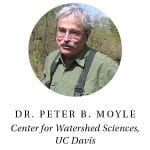
Peter Moyle is the Distinguished Professor Emeritus in the Department of Wildlife, Fish and Conservation Biology and Associate Director of the Center for Watershed Sciences, at UC Davis. He is author or co-author of more than 240 publications, including the definitive Inland Fishes of California (2002). He is co-author of the 2017 book, Floodplains: Processes and Management for Ecosystem Services. His research interests include conservation of aquatic species, habitats, and ecosystems, including salmon; ecology of fishes of the San Francisco Estuary; ecology of California stream fishes; impact of introduced aquatic organisms; and use of floodplains by fish.
Robert Lusardi is the California Trout/UC Davis Wild and Coldwater Fish Researcher focused on establishing the basis for long-term science specific to California Trout’s wild and coldwater fish initiatives. His work bridges the widening gap between academic science and applied conservation policy, ensuring that rapidly developing science informs conservation projects throughout California. Dr. Lusardi resides at the UC Davis Center for Watershed Sciences and works closely with Dr. Peter Moyle on numerous projects to help inform California Trout conservation policy. His recent research interests include Coho salmon on the Shasta River, the ecology of volcanic spring-fed rivers, inland trout conservation and management, and policy implications of trap and haul programs for anadromous fishes in California.

Patrick Samuel is the Conservation Program Coordinator for California Trout, a position he has held for almost two years, where he coordinates special research projects for California Trout, including the State of the Salmonids report. Prior to joining CalTrout, he worked with the Fisheries Leadership & Sustainability Forum, a non-profit that supports the eight federal regional fishery management councils around the country. Patrick got his start in fisheries as an undergraduate intern with NOAA Fisheries Protected Resources Division in Sacramento, and in his first field job as a crew member of the California Department of Fish & Wildlife’s Wild and Heritage Trout Program.